Research

A detailed overhead view of a researcher’s wooden worktable displaying an organized spread of archival materials about historic New South Wales cemeteries: folded parish maps, sepia-toned survey plans, neatly labeled manila folders, a magnifying glass, and a modern tablet showing a georeferenced digital map with faint cemetery outlines. Soft studio lighting from the upper left creates gentle, directional highlights on the crisp paper edges and tablet screen while leaving muted shadows in the corners. The composition uses a flat-lay, photographic realism style with sharp focus across the entire frame, conveying a meticulous, professional atmosphere of careful archaeological and historical investigation without showing any people.

We investigate forgotten burial grounds using archaeology and mapping to locate and interpret mortuary sites across New South Wales.

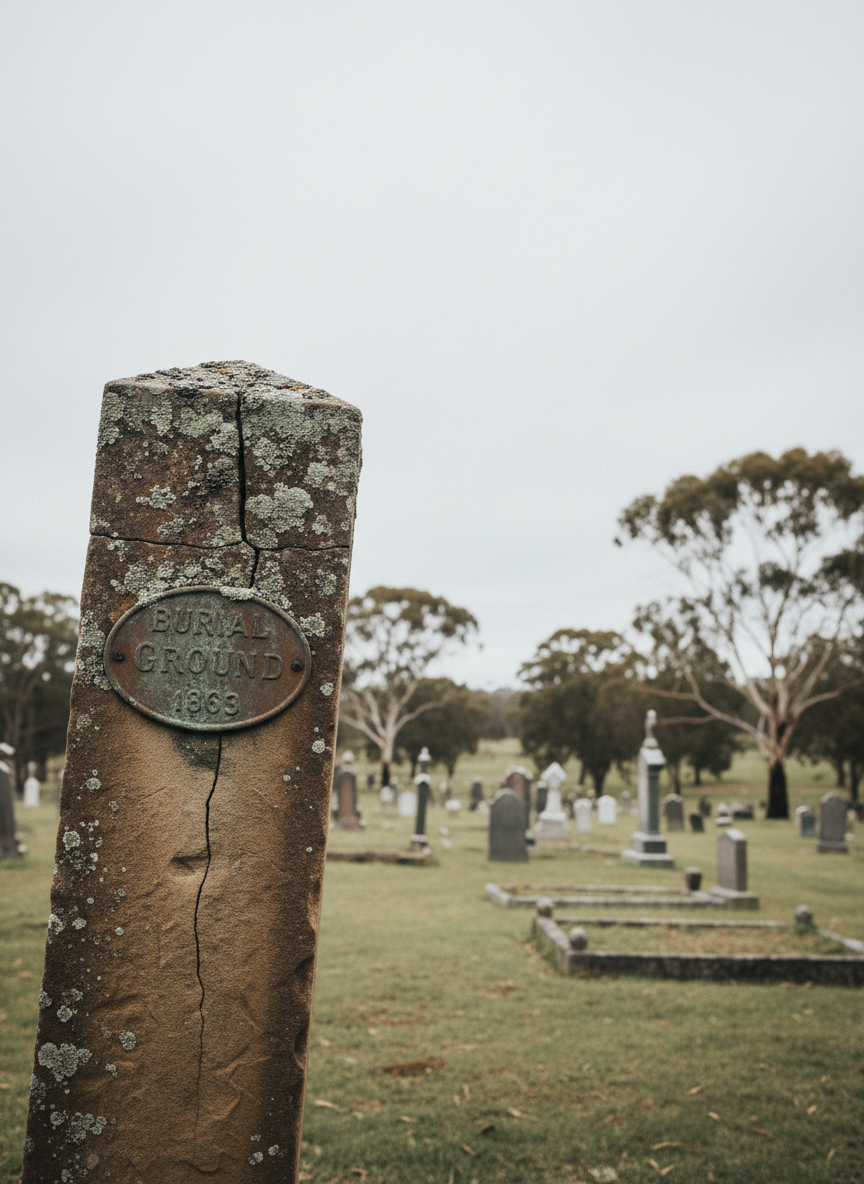
An isolated, weathered marble headstone leaning slightly forward in a neglected bush cemetery, its inscription nearly erased by time and covered in fine grey lichen and faint orange rust stains. Surrounding it, dense native grasses, fallen eucalyptus leaves, and scattered broken stone fragments create a textured, organic foreground. Early morning mist hangs low between tree trunks in the background, softening the distant forms. Cool, diffused natural light brings out subtle tonal variations in the marble. Photographed at a low, three-quarter angle in realistic style, with the headstone placed on the right third and the background gently blurred, the mood is quiet, solemn, and investigative, ideal for heritage-focused storytelling.

Our team collaborates with councils, Traditional Owners, and local communities to protect burial places, inform decisions, and support respectful commemoration.

A partially sunken, unmarked grave depression in dry, yellowed grass on the outskirts of a small rural New South Wales town, its subtle oval hollow barely visible except for a faint stone border and scattered wildflowers. Rusted wire fencing and distant gum trees frame the background under soft late-afternoon golden light, which rakes across the uneven ground, emphasizing texture and contour. Captured from a slightly elevated angle in photographic realism, with shallow depth of field that keeps the depression sharply defined while the town’s edge fades into a warm, hazy blur, evoking a quiet, contemplative mood about forgotten burials in the Australian landscape.

Uncovering Forgotten Burials

Gone But Not Forgotten NSW documents lost cemeteries, unmarked graves, and Aboriginal burial heritage across the Hunter Region and wider New South Wales through archaeological investigation, oral history, mapping, and photography, reconnecting communities with their overlooked mortuary landscapes.

A carefully excavated archaeological test trench cut into reddish-brown soil on a grassy hillside, its straight, clean edges revealing distinct soil layers and a faint linear stain indicating a possible historic grave cut. Numbered context tags, a scale bar, and a north arrow are precisely arranged at the trench edge, while a gridded planning frame lies nearby. Overcast daylight produces even, shadow-free illumination that clearly defines each stratigraphic layer in photographic realism. Captured from a slightly elevated, diagonal angle for depth, the trench fills most of the frame with the surrounding paddock and distant tree line softly receding, conveying a meticulous, professional mood centered on methodical forensic archaeology.
A close-up, oblique view of an old, hand-drawn parish map of coastal New South Wales spread out on a dark archival table, showing delicately inked cemetery symbols, winding roads, and shaded topography. Transparent tracing paper overlays part of the map, bearing modern, color-coded annotations that highlight “burial reserve” and “unmarked graves” areas. A metal archival ruler aligns with the map’s scale bar. Warm directional light from a desk lamp creates gentle highlights on the slightly wavy paper texture and pronounced shadows under the ruler. Photographic realism with a shallow depth of field keeps the map’s central annotated area razor sharp, while edges fall into a soft blur, suggesting focused, analytical heritage research.
A forgotten coastal burial ground perched above a quiet New South Wales beach, viewed from a slightly elevated vantage point. Low, crumbling stone kerbs outline a few indistinct grave plots among coarse dune grasses and small coastal shrubs, while beyond, pale sand and calm blue-grey water stretch to the horizon. Late-afternoon light breaks through thin clouds, casting a cool, muted glow across the scene, with soft highlights catching on scattered shells and weathered stone. Shot in photographic realism with moderate depth of field and a balanced composition placing the burial ground in the foreground third, the atmosphere feels reflective and melancholic, emphasizing the fragile intersection of mortuary heritage and changing coastal landscapes.

Contact team

Share site information, family histories, or questions about forgotten graves; we welcome enquiries from communities across New South Wales.

← Back

Thank you for your response. ✨